A RESEARCH WORKBENCH · VOL. 01 / 2026
A small battery.
A consequential
dispatch decision.
Explore a recording-energy estimate, test a battery budget, and replay the decisions in a saved research scenario.
Open the energy desk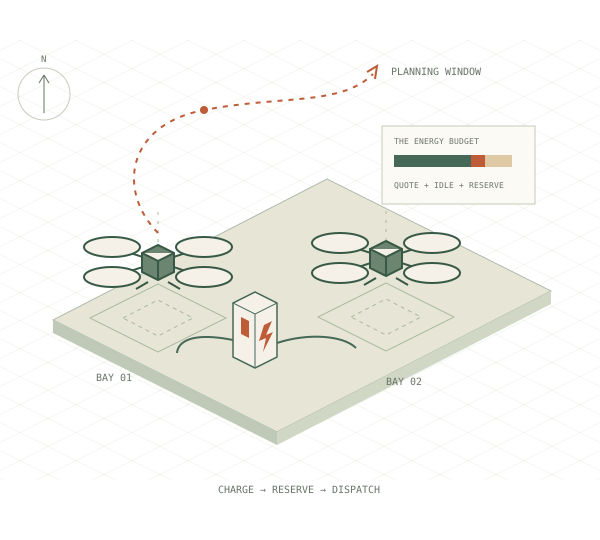
Loading the saved research artifacts…
Start with the recording.
DJI Matrice 100 · R1 logging protocol · energy in watt-hours
Only combinations observed on the selected date are available. Date selects a frozen development fold; it is not a weather input.
What does this estimate cover?
Signed, trapezoidal whole-recording electrical energy, including logged ground portions. The exported Ridge model uses speed, payload, altitude and inverse speed. It does not estimate an arbitrary route or another drone.
The paired upper value uses four calibration-date maximum signed residuals, with a finite nominal 80% rank. Finite 90% and 95% bounds are unavailable here. Development reuse does not establish a deployment guarantee.
Leave room for the reserve.
One hypothetical admission decision using the estimate above.
BATTERY BUDGET
—
- Required + reserve
- —
- Available margin
- —
- Outside-window idle
- —
Admission arithmetic only. A positive margin does not establish fleet feasibility or safety.
A policy has trade-offs.
Browse the original saved simulation outputs. Changing a selector does not run a new simulation.
Mean stream completion rates are averaged across 48 streams. Pooled completion divides total completed by total offered.
| Saved outcome | Point | Upper 80% |
|---|
These are hypothetical dispatch scenarios driven by development recordings. S17 changes several assumptions together. Reserve breaches remain under the upper policy in S17; no global safety claim follows.
Watch the saved decisions.
Two predesignated scenarios · stream 0 · exact event snapshots
THE EVENT LEDGER
Initial state
Battery stock in Wh at saved events. Steps hold the last logged value; the lines are not continuous physical trajectories.
The depot is a conceptual diagram. States and numbers come from saved event rows. Completion rows retain the state logged just before cleanup. Arrow keys step; Space plays; Escape exits presentation mode.
Inspect the current raw event
Keep the evidence in view.
A compact guide to what this workbench supports.
Model and calibration
Fixed Ridge regression (α = 1, SVD), StandardScaler and four predeclared planning features. This interface reproduces 12 exported development folds. Each excludes its selected evaluation date, uses seven proper-training dates and four calibration dates, and pairs the point estimate with its own group-maximum signed-residual margin.
For nominal 80%, rank ceil((4 + 1) × 0.8) = 4 is finite. Ranks for 90% and 95% exceed the four calibration dates. A nominal level is not a demonstrated operational coverage guarantee. Component range checks do not establish joint physical validity.
Dispatch semantics
Planning requirement = chosen recording quote + additional outside-window idle W × seconds / 3600. Admission requires requirement + reserve ≤ usable full capacity and ≤ available stock, with the frozen 10⁻⁸ Wh tolerance. Invalid inputs are rejected. The single-request calculator does not run the queue or charger model.
The saved model uses FCFS without bypass, the highest-stock idle vehicle with ID ties, FIFO charging and nonpreemptive full charging. The 8-hour arrival window is followed by draining and all-full recharge closeout. Post-window charging contributes to total grid input. Demand stress affects realized energy only, not the planning quote.
Saved results and replay
18 frozen hypothetical scenarios × 12 development dates × 4 streams × 2 policies = 1,728 saved policy rows. Scenario means average 48 streams. A pooled fraction uses total completed / total offered. Synthetic arrivals and charging assumptions do not establish real fleet performance.
Only S00 and S17, replication 0, have detailed predesignated event histories here: 157 rows per S00 policy and 220 per S17 policy, 754 in total. Both policies have identical closeout outcomes in these selected stream-0 replays; their broader trade-offs appear across all 48 streams. No histories are fabricated for other streams. The playback advances through ordered logged snapshots; simultaneous events preserve saved order.
Dataset, attribution and limits
Rodrigues and colleagues’ Data Collected with Package Delivery Quadcopter Drone, version 1 ↗, Carnegie Mellon University, is distributed under CC BY 4.0 ↗. Related Scientific Data paper ↗.
Derived parsing, QC, signed recording energy, model and simulation artifacts by Samer Abaddi, IDentity Research, 2026. Source authors do not endorse this derivative. Full attribution ↓
One drone platform and recording protocol. Logged ground portions remain. No wind, route-distance, temperature, battery age or brand extrapolation. Final-evaluation data and final models are excluded from this website. The frozen study artifacts are unchanged.
Separate flight-feasibility clip
A supplementary 10-second CPU PyBullet feasibility run, using the default CF2X Crazyflie and upstream DSLPID controller. It is separate from the Matrice 100 energy study and does not validate battery energy, dispatch outcomes or physical flight. Position RMSE: 0.093 m; maximum error: 0.111 m.
gym-pybullet-drones commit 15c426c85ac8e7a5db66d8b100f48858133357f6. MIT · © 2020 Jacopo Panerati. Licence ↓
Privacy, preservation and exports
This demonstration is open to visitors without a ChatGPT account. The browser receives the model parameters and saved development results needed by the interface; those served artifacts can be downloaded.
All calculations and exports run in your browser. The workbench code adds no analytics, user uploads, account database or third-party asset calls. Hosting is provided separately from ChatGPT. Exports contain the selected assumptions, units and evidence context. A versioned portable source archive accompanies this demonstration; long-term hosted availability and future pricing are not guaranteed.